First, take a look at the following spec sheet.
| Chassis | Dry carbon monocoque (CFRP) |
| Suspension | Öhlins / WP (fully adjustable dampers) |
| Weight | 15kg – 25kg |
| Top speed | 120km/h or higher |
| 0-100km/h acceleration | Achieved by gravitational acceleration alone |
| Brakes | None |
This isn’t about an F1 car. These are the specs for a machine to be used at the 2026 Milan-Cortina Paralympics.
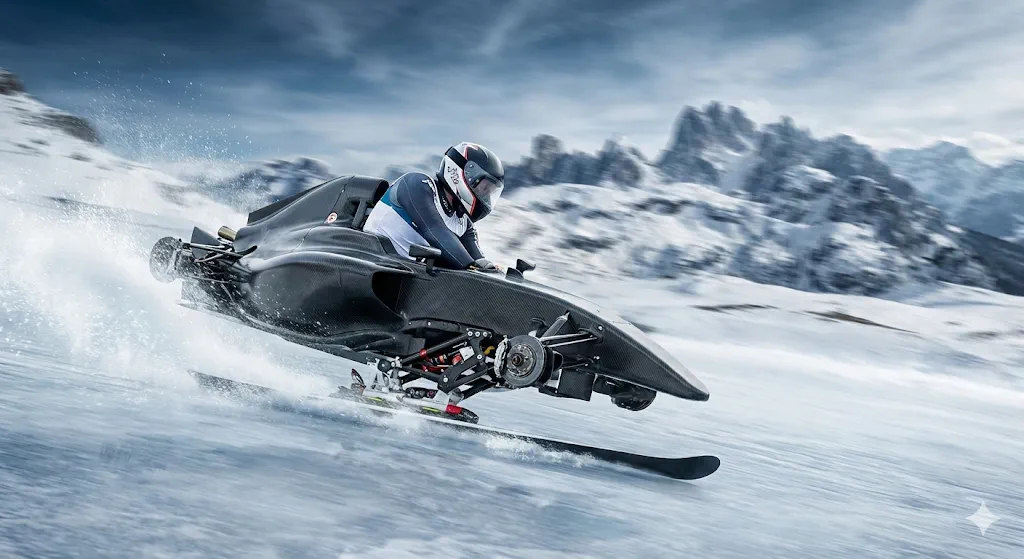
In fact, these are the specs for a sit-ski (chair ski) used in Paralympic alpine skiing.
When it comes to equipment for disabled sports, it’s often thought of as an extension of welfare equipment. However, the sit-ski fundamentally overturns that perception.
This is a “snow fighter jet” packed with Italy’s proud supercar technology – something unimaginable from the words ‘chair’ or “sled”.
It’s not a “chair”; it’s a “monocoque”.
This is footage of Japanese athlete Momoka Muraoka’s gold medal-winning run at the 2022 Beijing Paralympics.
Up close, sit-skis captivate with their sheer rigidity. While aluminum pipe frames were once the norm, carbon fiber (CFRP) is now standard.
Why? … To withstand the impact of crashing into an icy washboard at 100 km/h.
Like an F1 cockpit, the monocoque body—built by layering and baking carbon fiber—robustly protects the athlete’s body while directly transmitting information from the snow surface to the brain.
The ultimate “butt sensor.”
This machine has no steering wheel or pedals. The only means of control is shifting your center of gravity.
Therefore, the bucket seat the driver sits in is meticulously molded using 3D scanning technology to fit the contours of the driver’s buttocks and thighs down to the millimeter.
Just as F1 drivers stake their lives on the seat’s fit, sit-ski athletes cannot shave off even a tenth of a second unless their body and machine become one “perfectly rigid unit.”
The DNA of Northern Italy’s “Motor Valley”
Italy, host of the Milan-Cortina Paralympics, is one of the world’s leading supercar nations.
Particularly in the northern Emilia-Romagna region, home to the headquarters of Ferrari, Lamborghini, and Maserati, lies the area known as the “Motor Valley.”
The Paralympics have also served as a stage where Motor Valley engineers hone their skills through friendly competition.
Development uniting companies, universities, and athletes
A prime example is Dallara, the company that dominates the world in racing car chassis manufacturing.
The handbike and sit-ski technology developed in collaboration with Alex Zanardi—a former F1 driver who became a hero after losing both legs and transitioning to para-athletics—is now the secret weapon of the Italian national team.
In the wind tunnel laboratory at the Politecnico di Milano, tests to reduce skiers’ drag coefficient (Cd value) are repeatedly conducted using the same equipment as Ferrari’s aerodynamic development.
By 2026, sit-skis equipped with cutting-edge “Made in Italy” technology will be deployed on the snowy mountains.
Eyes level with 50cm above the ground, perceived speed 200km/h.
The site where sit-skis, manufactured with the pinnacle of technology, are operated. This place is far more feared than standing skis.
Reason1 Ground Rush Effect
The rider’s eye level is a mere 50cm to 60cm above the snow surface—the same low height as an F1 driver.
The speed of the passing scenery (optical flow) feels extremely fast, with the perceived speed said to be about twice the actual measured speed, reaching over 200km/h.
Reason 2 The Terror of Having No “Knees”
This is the greatest risk. Able-bodied skiers can absorb the impact of gaps using their knees as suspension.
But para-athletes lack this. The moment the machine’s suspension bottoms out beyond its limits, that impact strikes the spine and brain directly.
Reason 3 Tumbling without brakes
Their skis are designed to remain attached during falls.
Therefore, once balance is lost, the 15kg machine and body remain integrated as one, tumbling at high speed for hundreds of meters. It is a complete free fall, with no ability to break the fall with hands or feet.
They are “pilots.”
When you see a sit-ski athlete take their place on the starting platform on TV, pay close attention to their movements.
On the starting gate, athletes don their helmets and adjust the damping force of their suspension. They resemble fighter pilots preparing for takeoff more than athletes.
They challenge walls of ice in carbon monocoque machines that lack brakes.
This fusion of madness and technology is the very essence of Paralympic alpine skiing.
The Milan-Cortina Paralympics: Not just machines, but infrastructure evolves too. What is the Italian obsession that put elevators in ancient ruins?