In February 2026, the Milan-Cortina Winter Olympics and Paralympics came to a close amid great excitement.
These Games demonstrated to us that the “conventional wisdom” surrounding the Olympics has changed.
Previously, the Winter Olympics were dominated by snow-rich nations in North America and Europe. However, the modern landscape of winter sports has shifted entirely away from the presence or absence of snow, to nations possessing “massive capital,” “infrastructure investment capabilities,” and “global talent acquisition strategies.”
We examine the data to uncover the untold story behind the immigration and naturalization policies—and the proxy wars of state capital—being waged by China, the Middle East, and the Global South, as revealed by the roster of medalists.
“Cross-border athletes” who broke through the barrier of climate
At the 2026 Milan-Cortina Games, athletes who overcame climatic and geographical challenges—despite lacking a tradition as a snow-rich nation—astonished the world.
Lucas Pinheiro Blaten (Brazil)
Lucas Pinheiro Blaten won the gold medal in the men’s giant slalom, bringing the first Winter Olympic gold medal to South America.
Although he was raised in Norway’s world-class training system, he changed his nationality to Brazil—his mother’s homeland and the country of his roots—to compete on the world stage.
The UAE team that took on the challenge from the desert
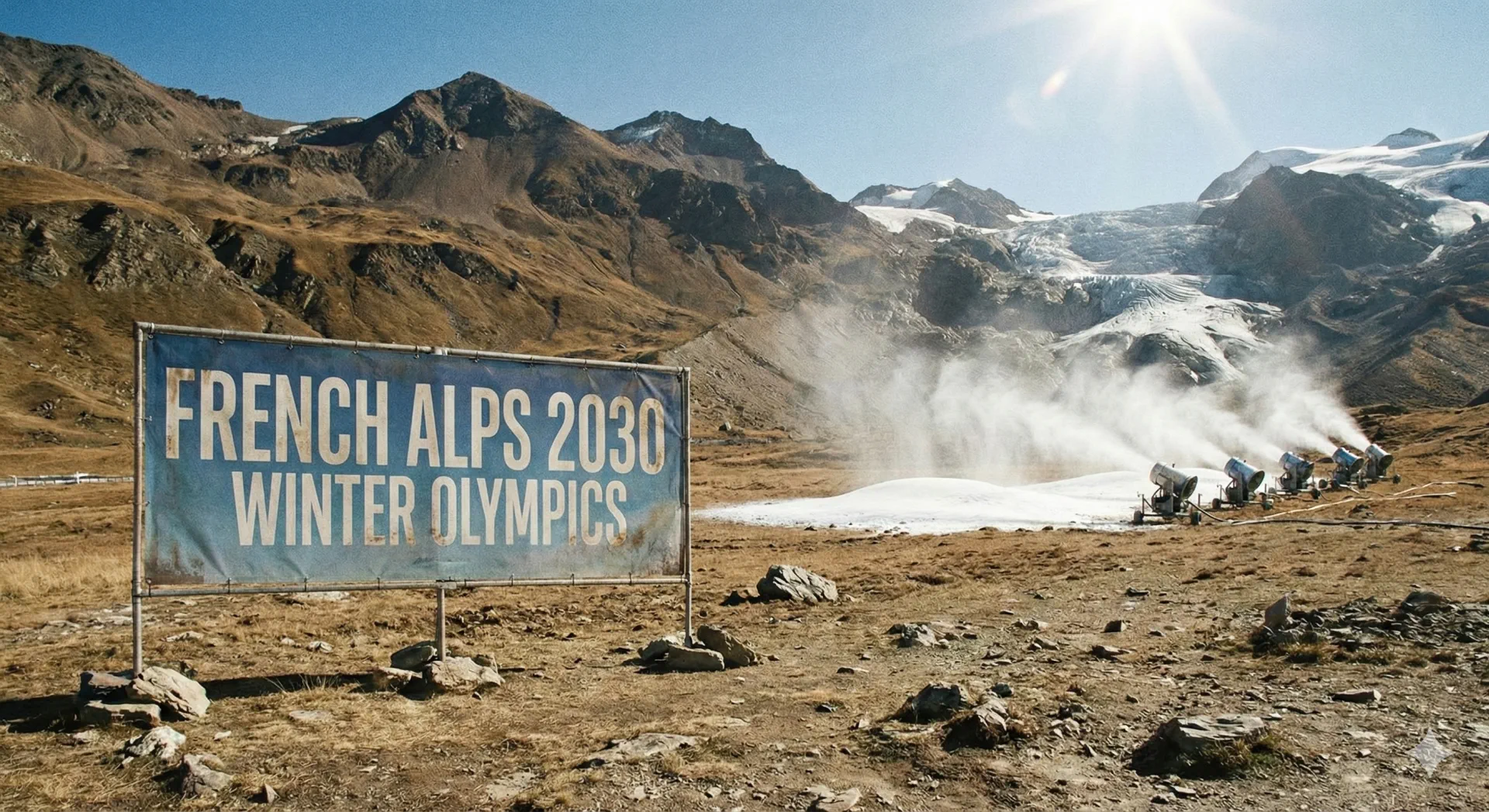
Although they didn’t win any medals, the United Arab Emirates (UAE) team sent athletes trained at the massive indoor ski resort “Ski Dubai” to the Olympic stage. This is a symbolic achievement in which a “country where it never snows” overcame its climate through technology and capital.
They proved that victory is no longer determined by whether or not snow falls in one’s country of birth.
Furthermore, this phenomenon of “individuals crossing borders” directly leads to a “grand strategy” in which non-snowfall nations aim for medals as a nation.
The “wall of wealth” standing in the way of winning medals
Winter sports are “capital-intensive sports” that require enormous amounts of money for dedicated facilities, artificial snow, expensive equipment, and even overseas training trips in search of snow.
Historical data suggests that for a country to develop the necessary infrastructure and consistently win medals at the Winter Olympics, it must overcome an invisible “wealth barrier” of approximately $30,000 in per capita GDP.
The only exception to this hurdle is China, which possesses both a massive economy and a national system capable of concentrating enormous budgets on specific sports.
Olympic Participation Strategies of the Global South and the Middle East
So, how did Middle Eastern countries and nations in the Global South—where it doesn’t snow and the financial barriers are high—manage to become hosts of the Winter Olympics?
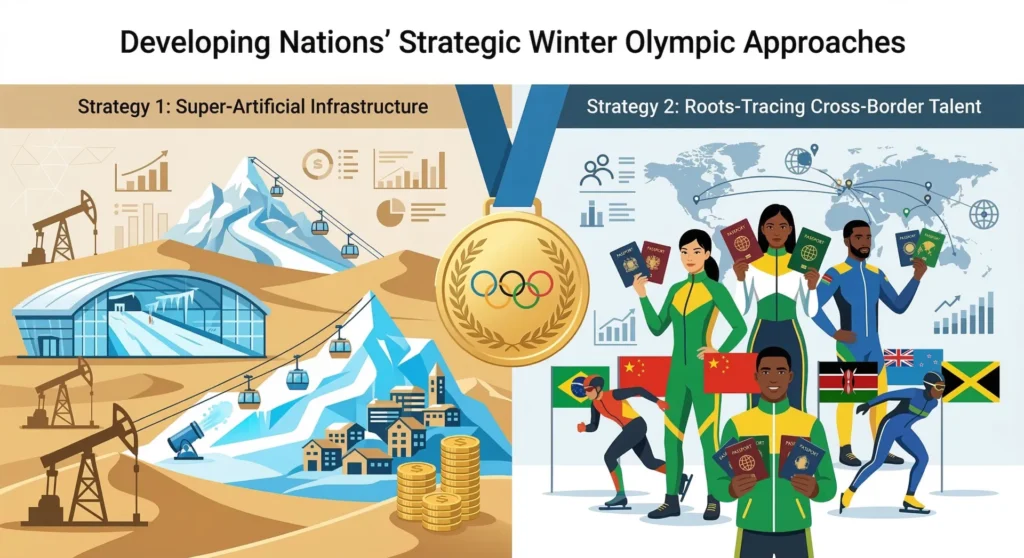
The Middle East: A Super-Artificial Infrastructure Strategy Fueled by Oil Money
Middle Eastern countries, with their vast wealth derived from oil, are attempting to forcibly create artificial snow environments within their own borders.
The UAE trained athletes at an indoor ski resort and sent them to the Milan-Cortina Games.
Meanwhile, Saudi Arabia moved forward with the construction of “Trojena,” an artificial ski village, as part of its $500 billion “City of the Future” project. However, financial difficulties and technical hurdles forced them to revise their plans.
If successful, this would send a powerful message to the world that “a desert nation has conquered snow,” but subduing the laws of nature is no easy feat.
A Cross-Border Strategy Tracing Global Southern Roots
In contrast, countries in the Global South have adopted an approach that avoids investing in domestic talent development, instead opting to naturalize mixed-heritage athletes and second-generation immigrants who were raised in the advanced training environments of Europe and the United States.
Brazilian athlete Blaten has demonstrated that this strategy allows these nations to avoid massive capital investments while achieving immediate results: raising their national flag on the Olympic podium, the ultimate stage.
[Strategy Comparison] Winter Olympic Approaches of Emerging Nations
Let’s compare the strategies of the Middle East with those of the Global South.
| Evaluation Criteria | Super-Artificial Infrastructure Strategy (Middle East) | A Cross-Border Strategy Tracing Our Roots (Global South) |
| Value for money | Not only does it involve enormous costs, but there is also a high risk of failure | You can aim for a medal without having to make massive capital investments or bear the associated risks |
| The Immediate Impact of National Branding | If we can make this a reality, we will be able to powerfully demonstrate to the world that we have “conquered the climate” | As a quick-fix strategy for winning medals, it helps boost national prestige |
The Social Structures of the World Reflected in Athletes’ Nationalities
Changes in athletes’ nationalities and the success of immigrants go beyond the realm of sports alone, serving as a mirror that reflects the social contradictions and dynamics within each region.
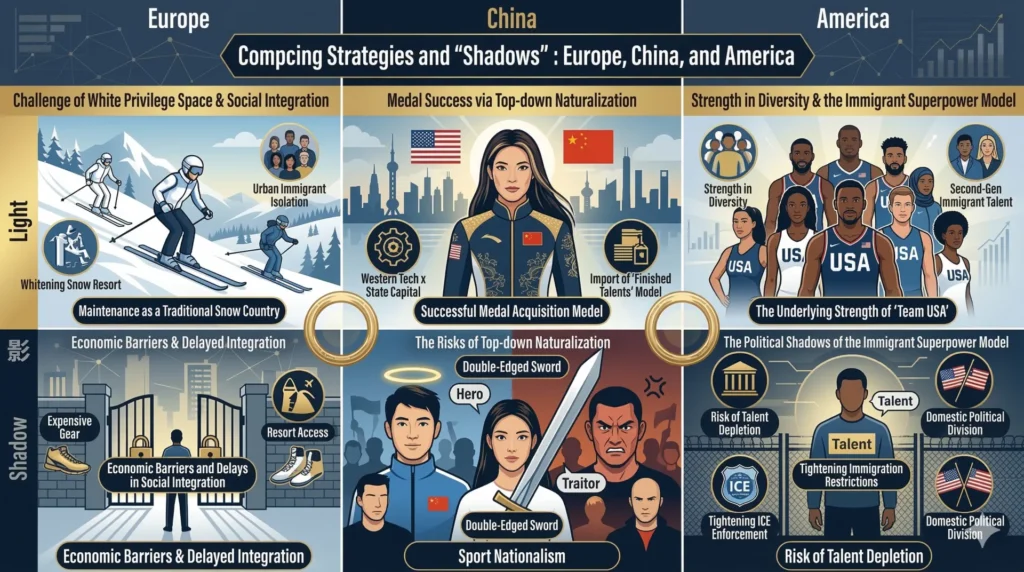
Europe’s “Invisible Inequality”
Sweden and other European countries today welcome a diverse range of immigrants. However, the overwhelming majority of athletes competing in the Winter Olympics are white.
This is because, for immigrants living in urban areas, access to ski resorts and the high cost of equipment present significant financial barriers. In Europe, winter sports remain a “privilege of the white,” serving as a mirror reflecting the reality of social integration across the continent.
China’s High-Risk, High-Reward Naturalization Strategy
China’s strategy of naturalizing top athletes trained abroad under state sponsorship has yielded starkly contrasting results.
Freestyle skier Eileen Gu (Gu Ailing), who was raised in the United States, successfully defended her gold medal, becoming the ultimate success story of the “Chinese model.”
On the other hand, the short track speed skating team—composed of naturalized athletes from Hungary and South Korea who had been highly anticipated—failed to win a medal and has become the target of fierce criticism and ostracism within China.
“Victory makes you a hero; defeat makes you a villain.” This has highlighted the precarious nature of sports nationalism in an authoritarian state.
The underlying strength and shadow of the United States, a nation of immigrants
In contrast to Europe, with its bias toward white people, and China, with its top-down approach, the United States demonstrated the resilience unique to a society built on immigration.
Of the 232 members of the U.S. delegation, 31 have immigrant parents, and 7 were born abroad. Athletes from diverse backgrounds, such as figure skater Alissa Liu—whose father came to the U.S. as a political refugee—are the foundation of America’s strength.
The “Shadow of Exclusion” Cast Over the United States
However, a dark shadow is beginning to fall over this robust “immigrant nation model.”
Tighter border controls within the country
Strengthened enforcement against undocumented immigrants by ICE (Immigration and Customs Enforcement)
A growing atmosphere of anti-immigrant sentiment in American society
These changes in the United States are raising the psychological and physical barriers for new talent seeking to come to America.
The narrowing of the door to the American Dream directly leads to a shortage of talent for future American teams.
Now that politics is attempting to discard diversity—America’s greatest weapon—it is extremely unclear how long America’s competitive edge can be maintained.
Summary
The modern Winter Olympics are no longer the “privilege of snowy nations.” Today, the Winter Olympics serve as a sensitive barometer for measuring a nation’s soft power, economic prosperity, and the success or failure of its immigration integration models.
In an era where climate barriers are being overcome through technology, capital, and the movement of people, the landscape of the Olympics will continue to undergo dramatic changes.
References
Olympic Arbitrage: Normalizing Success at the 2026 Winter Olympics – Advisor Perspectives, https://www.advisorperspectives.com/dshort/updates/2026/03/05/olympic-arbitrage-normalizing-success-at-the-2026-winter-olympics
The (Winter) Olympics by numbers: For people who love data and sports (but mainly data), https://www.actuaries.asn.au/research-analysis/the-winter-olympics-by-numbers-for-people-who-love-data-and-sports-but-mainly-data
Olympic Arbitrage: Who ACTUALLY Won the 2026 Winter Games? – YouTube, https://www.youtube.com/watch?v=SwEkf6m74Z8
Final medal count at the 2026 Milan Cortina Winter Olympics and …, https://www.nbcolympics.com/news/final-medal-count-2026-milan-cortina-winter-olympics-and-paralympics
2026 Winter Olympics medal table – Wikipedia, https://en.wikipedia.org/wiki/2026_Winter_Olympics_medal_table
2026 Milano Cortina Winter Olympics Medal Count and Standings – FOX Sports, https://www.foxsports.com/winter-olympics/standings
2026 Winter Olympics – Wikipedia, https://en.wikipedia.org/wiki/2026_Winter_Olympics
United Arab Emirates at the 2026 Winter Olympics – Wikipedia, https://en.wikipedia.org/wiki/United_Arab_Emirates_at_the_2026_Winter_Olympics
UAE makes historic Winter Olympics debut at Milan-Cortina 2026 – The Times of India, https://timesofindia.indiatimes.com/world/middle-east/uae-makes-historic-winter-olympics-debut-at-milan-cortina-2026/articleshow/128022596.cms
Milano Cortina 2026 in numbers: record engagement, efficient delivery, world-class performance – Olympics.com, https://www.olympics.com/ioc/news/milano-cortina-2026-in-numbers-record-engagement-efficient-delivery-world-class-performance
Who’s Representing MENA at the 2026 Winter Olympics – Scoop Empire, https://scoopempire.com/whos-representing-mena-at-the-2026-winter-olympics/
What is Saudi Arabia’s intention in taking over the Asian Winter Games? – EqualOcean, https://equalocean.com/analysis/2025032521443
2029 Asian Winter Games – Wikipedia, https://en.wikipedia.org/wiki/2029_Asian_Winter_Games
Saudi Arabia cancels the Asian games at Neom’s Trojena – Green Prophet, https://www.greenprophet.com/2026/02/saudi-arabia-cancels-the-asian-games-at-neom/
Neom replaced by Almaty: Why 2029 Asian Winter Games just abandoned Saudi Arabia’s $500B megacity – The Indian Express, https://indianexpress.com/article/world/almaty-replaces-neom-saudi-arabia-2029-asian-winter-games-host-relocation-10518908/
Saudi Arabia – Official Milano Cortina 2026 Olympic Team Profile, https://www.olympics.com/en/milano-cortina-2026/results/noc-profile/ksa
Lucas Pinheiro Braathen wins giant slalom gold for Brazil’s first Winter Olympics 2026 medal, https://www.olympics.com/en/milano-cortina-2026/news/lucas-pinheiro-braathen-wins-giant-slalom-gold-brazil-s-first-ever-winter-olympics-medal
Pinheiro Braathen claims giant slalom, earns Brazil’s FIRST Winter Olympic gold medal | NBC Sports – YouTube, https://www.youtube.com/watch?v=a9iU-XAGEgs
Pinheiro Braathen sambas into immortality with Brazil’s first ever Winter Olympic medal | NBC Sports – YouTube, https://www.youtube.com/watch?v=6S5QbQ6o6gc
Brazil Makes History: Lucas Pinheiro Braathen Wins Olympic Gold – Ski Racing Media, https://skiracing.com/lucas-pinheiro-braathen-olympic-gold-brazil-first-winter-medal-mens-gs-bormio-2026/
Philippines – Official Milano Cortina 2026 Olympic Team Profile, https://www.olympics.com/en/milano-cortina-2026/results/noc-profile/phi
Morocco – Official Milano Cortina 2026 Olympic Team Profile, https://www.olympics.com/en/milano-cortina-2026/results/noc-profile/mar
Athletes Thailand – Milano Cortina 2026 Olympic Athletes – Biographies, Medals & More, https://www.olympics.com/en/milano-cortina-2026/results/hubs/individuals/athletes/tha
Winter Olympics 2026 Opening Ceremony, Parade of Athletes: Which country goes first, https://www.olympics.com/en/milano-cortina-2026/news/parade-of-athletes-winter-olympics-2026-first-country-list
Europe’s rising diversity is not reflected at the Winter Olympics …, https://www.foxsports.com/articles/winter/europes-rising-diversity-is-not-reflected-at-the-winter-olympics-culture-plays-a-big-role
Europe’s rising diversity is not reflected at the Winter Olympics. Culture plays a big role, https://apnews.com/article/winter-olympics-diversity-integration-5bfec64352581e0eacb8c15620c632ad
Contributions of naturalized skaters should not be neglected despite disappointing outcome at Olympics – Global Times, https://www.globaltimes.cn/page/202602/1355681.shtml
Eileen Gu defends gold as China goes tops in freeski halfpipe | Winter Olympics 2026 | NBC Sports – YouTube, https://www.youtube.com/watch?v=_ldyO_x9DIY
Eileen Gu defends halfpipe gold, leaves Milan Cortina with 3 medals – NBC Olympics, https://www.nbcolympics.com/news/eileen-gu-defends-halfpipe-gold-leaves-milan-cortina-3-medals
Eileen Gu on her historic Winter Olympics 2026: “A rising tide raises all boats”, https://www.olympics.com/en/milano-cortina-2026/news/eileen-gu-on-historic-winter-olympics-2026-rising-tide-raises-all-boats
Alysa Liu vs Eileen Gu — How two Chinese American stars wound up on opposite sides of an Olympic proxy war – WFMD, https://www.wfmd.com/2026/02/21/alysa-liu-vs-eileen-gu-how-two-chinese-american-stars-wound-up-on-opposite-sides-of-an-olympic-proxy-war/
Chinese Media Blames Lin Xiaojun for Short Track’s Goldless Olympics, https://www.chosun.com/english/sports-en/2026/02/22/O5SGQVTTBND7TGI4PIZQAGGMJA/
Lim Hyo-jun – Wikipedia, https://en.wikipedia.org/wiki/Lim_Hyo-jun
LIN Xiaojun – Olympic Short Track Speed Skating Athlete | Milano Cortina 2026 Olympics, https://www.olympics.com/en/milano-cortina-2026/results/athlete-details/35962
2026 Winter Olympics by the numbers: The athletes, events and milestones of the Milano Cortina Games – CBS News, https://www.cbsnews.com/news/2026-winter-olympics-milano-cortina-numbers/
The role of immigrants in the 2026 Winter Olympics Team USA | The Tower, https://www.towerphs.com/articles/2026/2/sports/The-role-of-immigrants-in-the-2026-Winter-Olympics-Team-USA-939
History in motion: A look at the Black athletes of the 2026 Winter Olympics, https://afro.com/black-athletes-shine-2026-olympics/
Black Athletes Break Barriers at 2026 Winter Olympics – Dallas Weekly, https://dallasweekly.com/2026/02/black-athletes-break-barriers-at-2026-winter-olympics/
Winter Games 2026: A Reflection of the Politicisation of International Sport? – IRIS, https://www.iris-france.org/en/jeux-dhiver-2026-un-reflet-de-la-politisation-du-sport-international/
Milan–Cortina 2026: The Employment Law Behind the Winter Olympic and Paralympic Games | Littler, https://www.littler.com/news-analysis/asap/milan-cortina-2026-employment-law-behind-winter-olympic-and-paralympic-games
List of participating nations at the Winter Olympic Games – Wikipedia, https://en.wikipedia.org/wiki/List_of_participating_nations_at_the_Winter_Olympic_Games
How Many Countries Are at the Winter Olympics? Complete Breakdown of Nations, https://www.si.com/winter-olympics/how-many-countries-complete-breakdown-nations-history-milan-cortino-games
Which Countries Have Participated in the Winter Olympics? | Map, Nations, Teams, & History | Britannica, https://www.britannica.com/sports/Which-Countries-Have-Participated-in-the-Winter-Olympics
Winter Olympic Games – Wikipedia, https://en.wikipedia.org/wiki/Winter_Olympic_Games