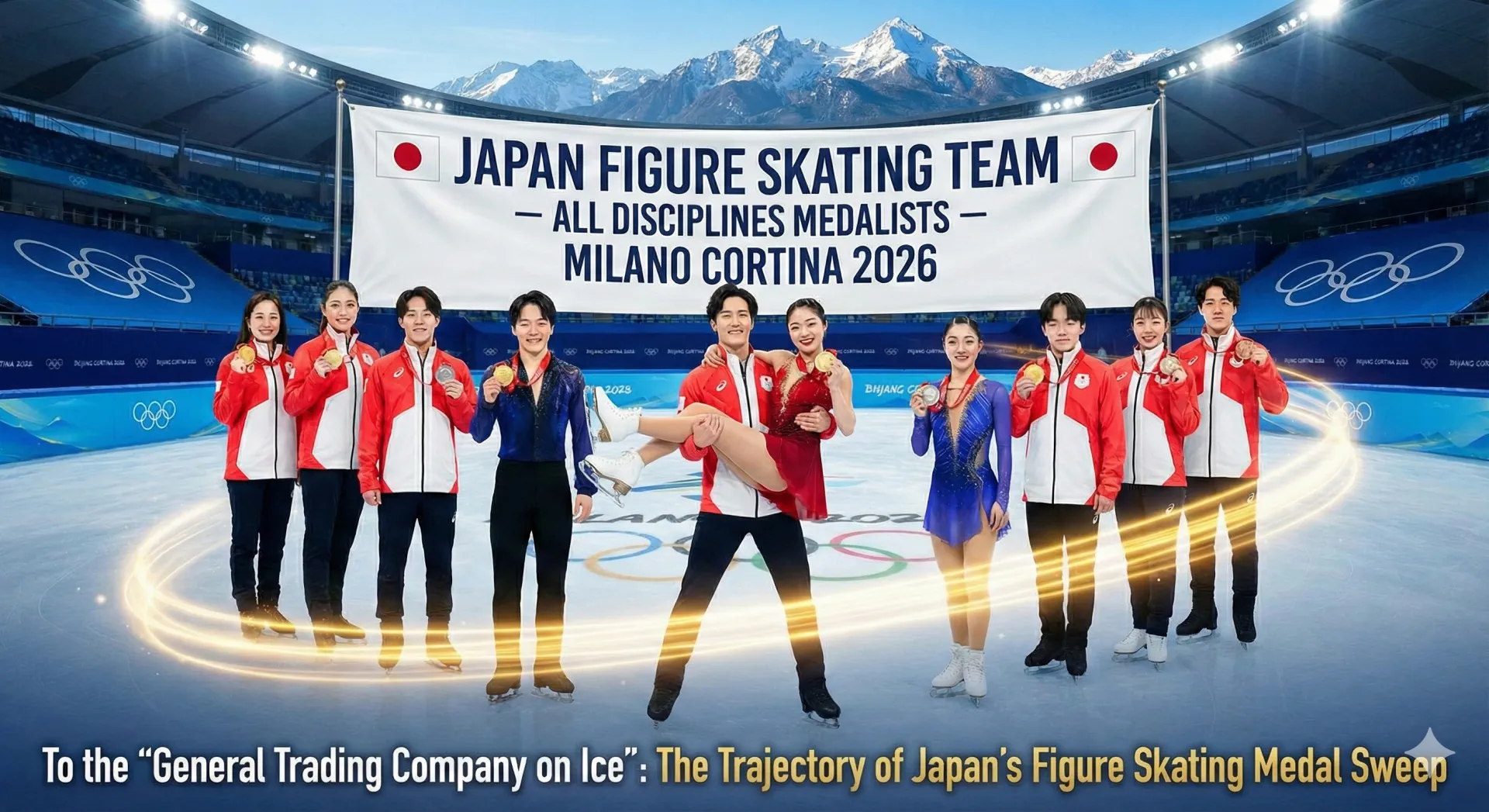
At the Milan-Cortina Winter Olympics held in February 2026, Japan’s figure skating community achieved a historic feat.
They won medals in every event: men’s singles, women’s singles, pairs, and the team competition.
The six medals were the most among all participating nations, proving Japan’s comprehensive strength to the world.
This article revisits the drama on the ice in Milan, traces Japan’s evolution from a nation reliant on women’s singles to an all-around powerhouse, and looks ahead to the future.
- The Six Medals That Shone on the Ice in Milan
- The history of relying on singles skaters
- The new stage that began in Beijing, and the leap forward in Milan.
- The path to becoming a “comprehensive trading company on ice.”
- Worldwide acclaim and the “silver disappointment” heading toward 2030
- You may also like to read
The Six Medals That Shone on the Ice in Milan
The Japanese national team achieved world-class results across all categories in Milan.
First-ever gold medal in pairs and highest score in history
The most dramatic event was the pairs competition.
The pair known as “Rikuryu,” Riku Miura and Ryuichi Kihara, started in fifth place after mistakes in the short program. However, they delivered a free skate performance that earned them a world record score of 158.13 points. With a total score of 231.24 points, they won Japan’s first-ever Olympic gold medal in pairs figure skating.
The image of their disappointment after the short program and their joy after the free skate will surely remain in our memories for a long time.
Double podium for men’s and women’s singles
In men’s singles, Yuma Kagiyama won silver and Shun Sato staged a dramatic comeback from 9th place in the short program to claim bronze, as the childhood friends achieved an emotional double podium finish.
In women’s singles, Kaori Sakamoto took silver and 17-year-old Ami Nakai won bronze, marking the first double podium finish for Japanese women in Olympic history.
Team spirit delivered silver in the team event
In the team competition, they secured the silver medal, narrowly trailing the United States by just one point.
Despite the risk of fatigue lingering into the individual events after consecutive competitions, the Miura-Kihara pair and Sakamoto competed in both the short program and free skate.
This demonstrated the results of the team uniting and working as one.
The history of relying on singles skaters
For a long time, Japan’s figure skating world relied on a structure centered around “one genius.”
The 90s and 00s: Relying on Women’s Singles
Two medals in figure skating from the 1990s to the 2000s. They were won in the solitary discipline of women’s singles, seized by the geniuses of that era fighting alone.
- The silver medal won by Midori Ito, who attempted the triple Axel at the 1992 Albertville Games
- Shizuka Arakawa’s gold medal at the 2006 Turin Games, where she dazzled with her Ina Bauer
These can truly be called two shining stars.
At that time, Japan was blocked by powerhouse nations like Europe, America, and Russia in pairs and ice dancing, unable to secure Olympic spots.
The 2010s saw a leap forward in men’s singles.
The 2010s brought some changes. This is where the men’s singles began to take off.
- At the 2010 Vancouver Games, Mao Asada won silver with her triple axel as her weapon.
- Similarly, Daisuke Takahashi won bronze.
- At the 2014 Sochi Games and 2018 Pyeongchang Games, Yuzuru Hanyu achieved historic back-to-back victories.
- At the 2018 Pyeongchang Games, Shoma Uno won the silver medal.
Indeed, the “stars” had increased.
However, the structure remained one of “relying on singles,” dependent on the outstanding talent and extraordinary effort of specific skaters.
The new stage that began in Beijing, and the leap forward in Milan.
The 2022 Beijing Games marked a new stage beyond relying solely on singles.
Alongside the achievements of Yuma Kagiyama (silver), Shoma Uno (bronze), and Kaori Sakamoto (bronze) in men’s and women’s singles, the team secured its first-ever medal in the team event. This was the moment when the strengthening of pairs skating, exemplified by the Miura Riku/Kihara Ryuichi pair, elevated the team’s overall strength.
The “star” became a “constellation” in Beijing.
Then, the structural reform from “reliance on a few individuals” to “organizational strength” bore fruit at the 2026 Milan-Cortina Games with “medals in every event.”
Finally, the “constellation” leaps into a “galaxy.”
This was not a coincidence, but an inevitability born from the Japan Skating Federation’s long-term strengthening vision and the advancement of its development environment.
The path to becoming a “comprehensive trading company on ice.”
Strengthening of Couples Competition
The Olympic team competition began, and the Japan Skating Federation keenly felt the need to strengthen its pairs program. The Federation will regularly hold an event called “Partner Tryouts.”
- Experience in pairs skating. Single skaters also participate, and this can be a turning point where they are identified as having aptitude for pairs and switch disciplines.
- Partner matching. Skaters actually hold hands while skating to assess physical compatibility and skating synergy.
Promising pairs were immediately placed under the guidance of top international coaches upon formation. Efforts to provide the world’s highest level of training environments and enhance artistic expression were also sustained.
Advancement of the training environment
Training environments have also made significant strides. Powerful development organizations, exemplified by Kyoto’s Kinoshita Academy, have become firmly established.
These facilities feature year-round access to international-standard rinks. Athletes no longer struggle with rink shortages or scramble to secure ice time. They can now consistently practice high-quality skating and jumps regardless of season or time.
Scientific training methods are also being implemented.
- Training is planned based on science and data, not just experience and intuition.
- Recovery is planned systematically, not just intense practice.
- Peaking physically and mentally is timed for major events.
These approaches have steadily strengthened the athletes’ abilities.
The bonds forged by Team Japan at their dedicated overseas training base
The special base established in Varese, Italy, played a major role during the Milan-Cortina Games.
- Meticulous conditioning by specialized staff
- Providing “winning meals” by Ajinomoto Co. … Thorough nutritional support
- Promoting communication among athletes in relaxation rooms and other spaces
This base provided comprehensive support for athletes, including fatigue recovery and mental care, fostering a strong sense of solidarity within Team Japan.

Worldwide acclaim and the “silver disappointment” heading toward 2030
Japan’s dominance at the Milan-Cortina Games also served as a source of motivation for the next challenge.
Japan’s overall strength, praised by international media
Japan’s remarkable progress drew generous praise from overseas media.
The deepest and most complete performance in its history
Korea Jun-An Daily
Japan pair knocks the King and Queen off their thrones
Puerto Rico’s San Juan Daily Star
(Regarding the gold medal won by the Ryuryu pair)
The Silver Regret That Fell Short of the Summit
On the other hand, many athletes experienced the bitter disappointment of falling just short of the top spot.
- The silver medal in the team event, falling one point short of overtaking the United States.
- The silver medal in men’s singles for Kagiyama.
- And the silver medal in women’s singles for Sakamoto, who shed tears declaring “it’s over” after a heartbreaking mistake while aiming for gold as her absolute goal…
The Japan Skating Federation hopes this frustration will become a catalyst for the next generation.
Skaters like Sakamoto and Kihara are already looking ahead to their future roles as coaches, nurturing the next generation. The skaters who shone on the ice in Milan will now cultivate the next gold medalists. A new ecosystem is beginning.