
On June 24, 2019, at the 134th IOC Session held in Lausanne, Switzerland, Milan and Cortina d’Ampezzo, Italy, were selected as the co-hosts for the 2026 Winter Olympics.
This marked Cortina d’Ampezzo’s second hosting after a 70-year gap and the first time in Olympic history that a bid was based on a multi-city hosting arrangement.
The Moment the Host City Was Announced
President Thomas Bach opened the envelope containing the host city’s name and announced loudly, “Milan-Cortina!” (Announcement starts at 2:59)
Ladies and gentlemen, the members of the International Olympic Committee have elected the host city of the Olympic winter games in 2026.
The host is … MILANO-CORTINA!
The Passion That Won the Hosting Rights: Milan-Cortina
From Rome’s Setbacks to Milan
The bid for Milan-Cortina was not merely a campaign; it was a long-cherished goal to overcome Rome’s repeated failures.
Rome had previously bid for both the 2020 and 2024 Summer Games, but was forced to withdraw due to financial difficulties and political turmoil. At the time, many in Italy believed the Olympics would leave a debt burden. Milan and Cortina d’Ampezzo transformed that sentiment.
Learning from Rome’s failures, the Italian government emphasized utilizing existing infrastructure and sustainability. Above all, it was the fervor of the Italian people that swayed the IOC members.
Overwhelming Support Secures the Bid
The decisive factor in Milan-Cortina’s victory was the overwhelming support of the Italian people.
An IOC survey revealed domestic support in Italy reached 83%, far surpassing the 50% range of the leading rival city, Stockholm-Åre. This almost frenzied level of support became the ultimate weapon, more than sufficient to dispel any other concerns.
At the moment of the decision, members of the Italian bid delegation, including football legend Paolo Maldini, who were present at the venue, jumped for joy and embraced each other like children.
Soon, a massive chorus of “Italia! Italia!” erupted from the venue and from the thousands of citizens packed into Milan’s Duomo Square.
The Crisis of Candidate City Shortage and the “New Norm”
The selection process for the 2026 Games marked a major turning point for the Olympics.
Initially, many cities like Calgary (Canada), Sion (Switzerland), and Sapporo expressed interest. However, they withdrew one after another due to ballooning hosting costs and local opposition. Only Milan-Cortina and Stockholm-Åre remained in the final selection.
Faced with this severe crisis, the IOC fully implemented the “New Norm.” Under this principle, which permits multi-city hosting to avoid new construction, Milan-Cortina presented a realistic plan utilizing existing or temporary facilities for over 90% of venues.
At the dawn of a transitional period reshaping the Olympics, Milan-Cortina’s proposal was highly praised as a new Olympic model.
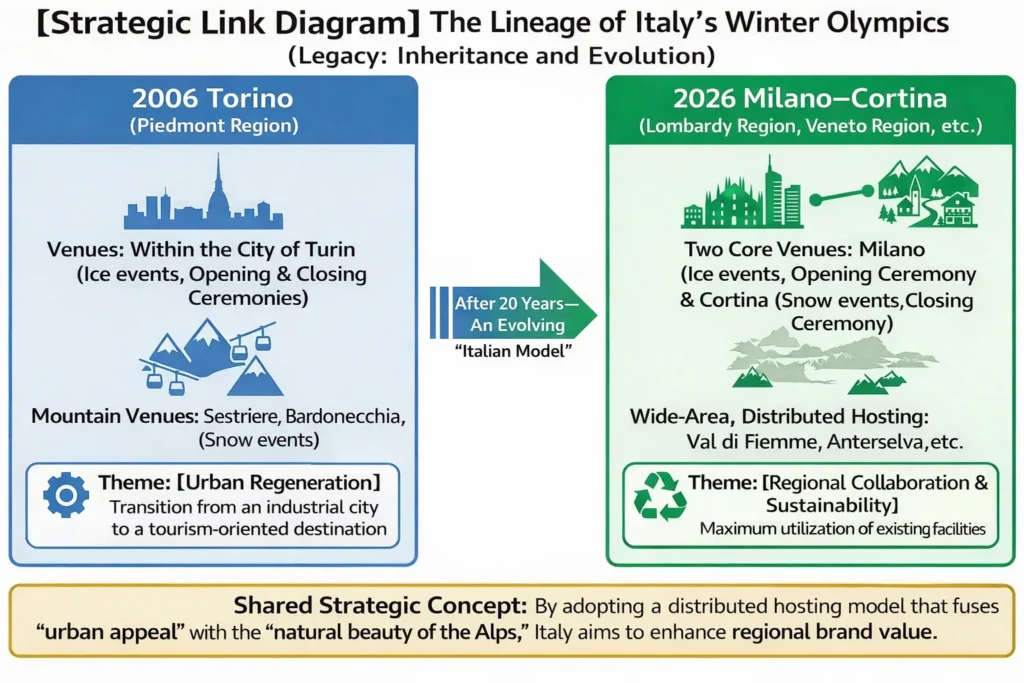
While the Milan-Cortina Games marked the first-ever “wide-area decentralized hosting by two major cities,” the strategic roots lie in the Turin Games hosted by Italy 20 years prior.
This is the lineage of how Turin’s successful model for revitalizing an industrial city was applied to Milan and Cortina.
Voting Results
In the final vote, Milan-Cortina defeated Stockholm-Åre by a margin of 13 votes.
| City Name | Votes |
| Milan-Cortina (Italy) | 47 |
| Stockholm-Åre (Sweden) | 34 |
| Abstention | 1 |
Let’s Watch the Milan-Cortina Olympics
The “existing facilities utilization plan,” which proved decisive in Milan-Cortina’s winning bid, means spectators face the grueling task of traveling across northern Italy to reach the venues.
Milan and Cortina are as far apart as Tokyo and Morioka, even in a straight line. Based on local information, we’ve compiled a travel strategy to ensure you reach this vast area without fail and navigate it efficiently.

References
- International Olympic Committee: Milan-Cortina 2026 – The Host City Election
- InsideTheGames: Milan-Cortina elected host of 2026 Winter Olympic and Paralympic Games
- The Guardian: Milan-Cortina to host 2026 Winter Olympics as IOC goes for ‘safe’ option
- Reuters: Italy’s Milan and Cortina awarded 2026 Winter Olympics
- BBC Sport: 2026 Winter Olympics: Milan-Cortina voted as host city
- JOC(Japan Olympic Committee): News on the Selection of the 2026 Winter Olympics Host City