The name of the 2026 Winter Games is “Milan-Cortina d’Ampezzo.”
While it sounds like a single city name, it is actually a multi-site event spanning two entirely different areas: the city of Milan and the mountain resort of Cortina.
Traditionally, the Olympics conjured images of all athletes gathering in one massive athletes’ village, but this time, that convention is overturned.
We explain the full scope of this historically most expansive and, in a sense, fragmented Games, born from the IOC’s Agenda 2020 reforms.
Even the straight-line distance is vast! A 5-hour drive: The “Ultra-Wide-Area Hosting”
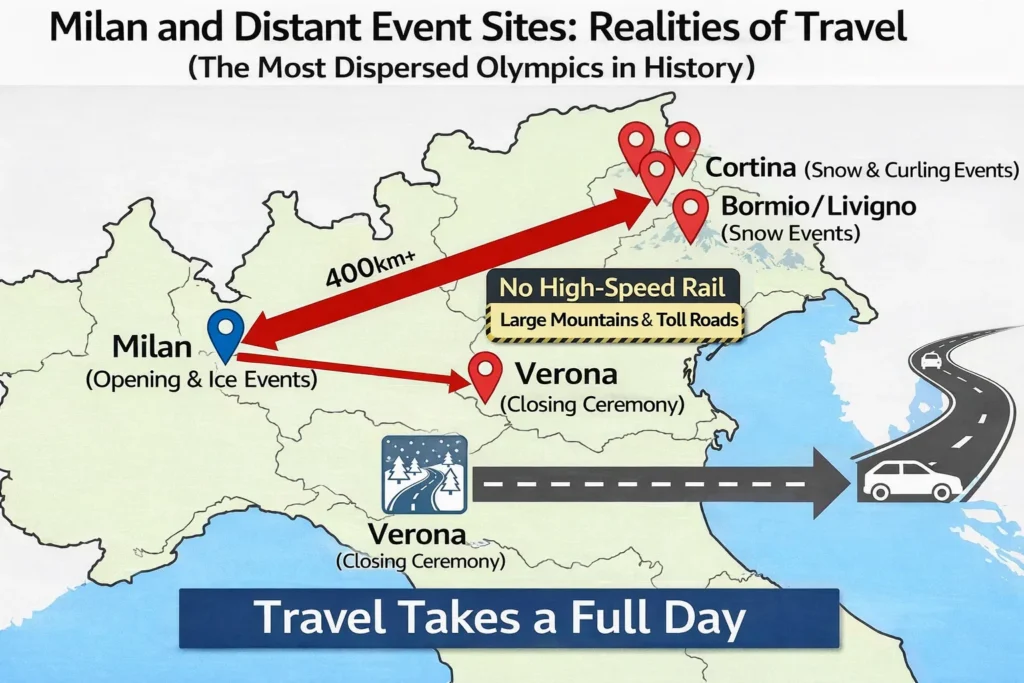
First, the distance between venues is astonishing.
Milan, where the opening ceremony takes place, and Cortina, hosting events like Alpine skiing and curling, are over 250km apart even in a straight line. Traveling by road takes 4-5 hours one way.
Furthermore, this time, venues are also scattered in locations like Val di Fiemme (for ski jumping, etc.) and Livigno (for snowboarding, etc.), positioned between the main venues. The entire Games are widely dispersed across northern Italy.
Why Did This Happen? The Merits and Demerits of “Agenda 2020”
Why did the layout become so inconvenient?
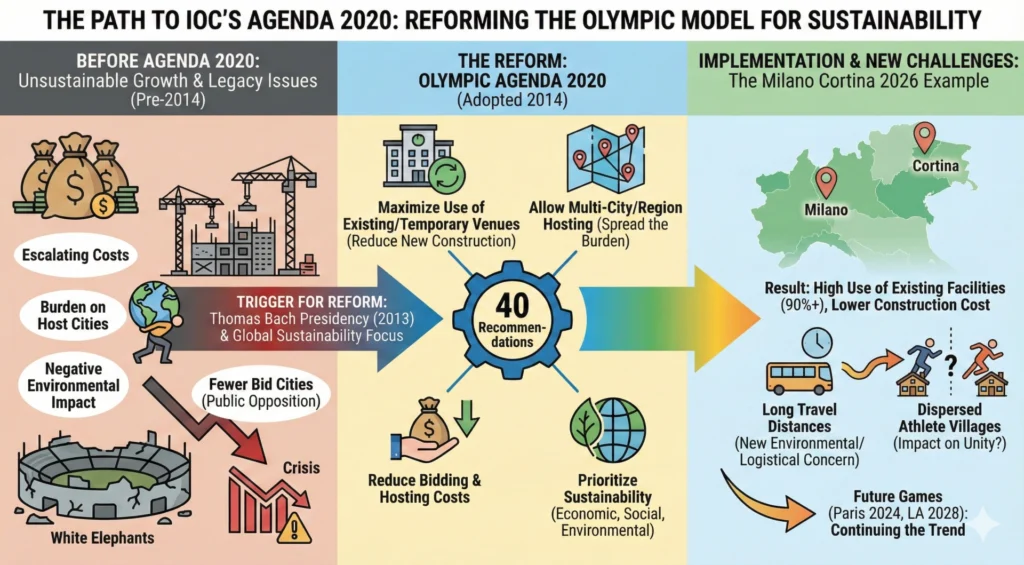
The primary reason lies in the reform guidelines “Olympic Agenda 2020” established by the IOC (International Olympic Committee).
- Previous Policy
Aiming for compact hosting, new facilities built in one location
→ Problems included massive construction costs and the risk of becoming a “negative legacy” after the Games - Agenda 2020’s New Policy
Minimize new construction, utilize existing facilities
→ Venues can be somewhat distant as long as facilities exist
The Milan-Cortina Games exemplify this thorough utilization of existing facilities.
However, a side effect is the dispersion of venues.
While the environmental impact of facility construction was reduced, a contradiction has been pointed out: CO2 emissions (environmental impact) from the movement of athletes and officials may increase.
Will the “sense of unity in the athletes’ village” be lost?
The decentralized hosting approach also impacts the athletes. Instead of building one massive athletes’ village, “athletes’ village clusters” will be established near each competition area.
- Benefits
Staying close to competition venues reduces travel stress, creating an environment conducive to focusing on competition. - Concerns
Opportunities for ice athletes (e.g., figure skating) and snow athletes (e.g., skiing) to interact will drastically decrease. The sense of unity as a festival may fade.
While this approach prioritizes practicality over glamorous interaction, the logistics of moving athletes for the opening and closing ceremonies remain a major challenge for the organizing committee.
“Transportation Plans” Are Vital for Spectators
Of course, for those watching events on-site, the dispersion of venues is also a critical issue.
Attempting to “watch figure skating in Milan in the morning and skiing in Cortina in the afternoon” is physically impossible.
Before securing tickets, grasping this geographical layout is the first step to planning a successful viewing experience.
The following article covers transportation options, getting to the venues, and local transportation systems.